// TARGET: GOVERNANCE_CHARTER_V1.0_
The Digital Asset Council (DAC) Charter
Architecting the Foundation of Sovereign Treasury Governance
Integrating digital commodities without a formalized governance architecture turns a strategic treasury advantage into a critical boardroom liability.
To safely command on-chain capital, enterprises must eliminate ad-hoc authorization and deploy a cross-functional Digital Asset Council (DAC). This briefing details the exact "Triad of Control" necessary to secure your infrastructure and provides the foundational Charter to initialize your institutional governance engine.
The Structural Deficit: The "Shadow Treasury"
Institutional failure in the digital asset economy rarely stems from external network exploits; it is almost entirely the result of internal protocol breakdown. For many organizations, early digital asset initiatives rely on a "Shadow Treasury"—a fragile web of ad-hoc emails, isolated developer actions, and informal verbal approvals.
When a single engineer controls the private keys, or an executive authorizes capital movement from an unvetted personal device, the corporate veil is pierced. In a deterministic on-chain environment, an authorization that is not formally codified in council minutes constitutes a direct breach of fiduciary duty.
The Solution: The Institutional Triad™
A sovereign treasury does not rely on a designated "crypto expert"; it relies on a ratified Digital Asset Council (DAC). The DAC is not an investment committee—it is a cross-functional architecture empowered by the Board of Directors to govern all digital infrastructure risk.
To achieve the operational standard, this Council must be anchored by three distinct seats of authority, forming the Institutional Triad™:
- 1. The Chair (Finance): The CFO or Treasurer. They define asset hiring criteria, orchestrate yield optimization, and drive balance sheet efficiency. They allocate the strategy.
- 2. The Shield (Security): The CISO or VP of Engineering. They architect the Key Management System (KMS), dictate the physical security layer, and enforce the digital signing quorum. They secure the rail.
- 3. The Guardrail (Legal): The General Counsel or CCO. They establish jurisdictional safe harbors, vet counterparties, and ensure strict alignment with global compliance frameworks. They define the boundary.
"Without all three acting in unison, you lack a Council; you possess a vulnerability."
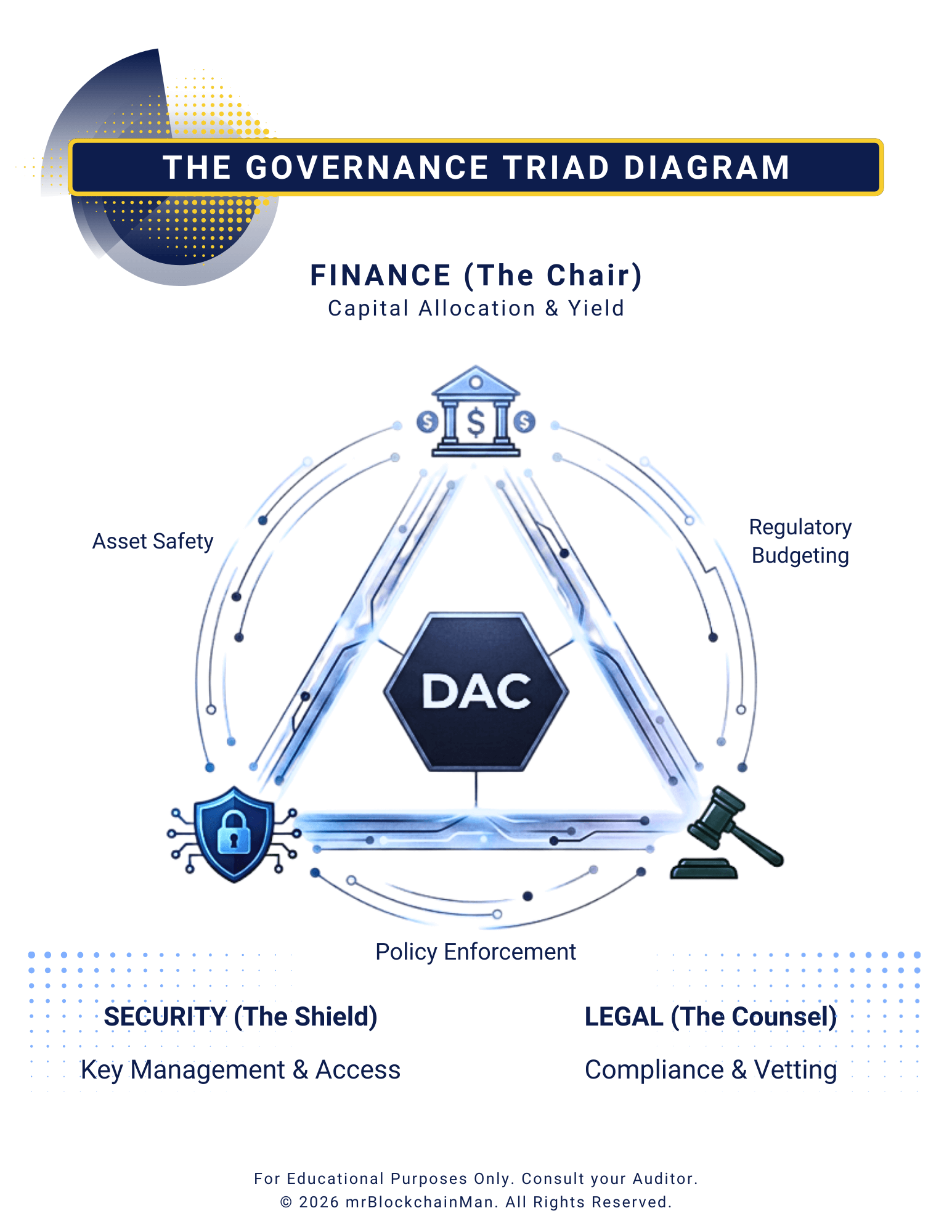
A trustworthy environment requires a 2-of-3 signing quorum across distinct departmental silos: Finance (Chair), Security (Shield), and Legal (Guardrail).
The Genesis Block: Ratifying the Charter
A Digital Asset Council is entirely theoretical until it possesses a Board-ratified Charter. This document serves as your institutional constitution. It explicitly defines the permitted scope of authority (the "Allow-List"), the deterministic voting quorum (how many distinct signatures are required to move capital), and the emergency protocol (the "Kill Switch").
Your enterprise's first action in the on-chain economy is not to deploy capital; it is to formalize the Charter. We do not speculate. We govern.
Establish Your Defense Before Day Zero
Defining the Triad is the prerequisite step. To help your enterprise formalize this architecture and eliminate classification liability, we have engineered the DAC Charter v1.0 Template.
> Initialize your credentials in the terminal below to dispatch the blueprint.