


 Gilbert Saldana
 // TARGET: MANIFESTO_BRIEFING_
Why Cryptos Matter for Today’s CFO
The Strategic Imperative for Stewards of Capital
In today’s economy, the role of Chief Financial Officer has fundamentally evolved. You are no longer just the steward of the balance sheet; you are the central strategic partner, expected to navigate unprecedented technological shifts and drive enterprise value.
This article is not about speculative investing. It is an executive briefing on a new, unavoidable shift in our financial infrastructure. Its purpose is to explain why digital assets have moved from a peripheral technological curiosity to a core strategic consideration for every modern financial leader.
More Than an Asset: A New Era of Digital Commerce
The first mistake many executives make is to view digital assets through the narrow lens of speculative investment. Their true significance is far broader.
These are the native components of a new, global, 24/7 “digital commerce” ecosystem. This ecosystem isn’t just a new market; it’s a new infrastructure. It provides a different set of rails for value transfer, impacting all three pillars of your financial operations:
- Operations: Enabling faster, cheaper, and more transparent payments and settlements.
- Investing: Unlocking new, programmable treasury assets and yield opportunities.
- Financing: Creating novel pathways for raising capital and engaging stakeholders.
To ignore this is to ignore a fundamental evolution in the “how” of global business.
The Real Innovation: Decentralized Transactional Trust
Why is this a fundamental innovation and not just a faster database? The true innovation is the establishment of decentralized transactional trust.
For centuries, commerce has relied on centralized intermediaries—banks, clearinghouses, and payment processors—to verify transactions and establish trust. This new infrastructure achieves trust through a different model: cryptographically-secured, shared, and immutable ledgers (blockchains). It is about auditable, transparent, and secure value transfer without traditional intermediaries.
“The financial world is undergoing a shift as fundamental as the move from single-entry to double-entry bookkeeping. We are moving toward Triple-Entry Accounting.”
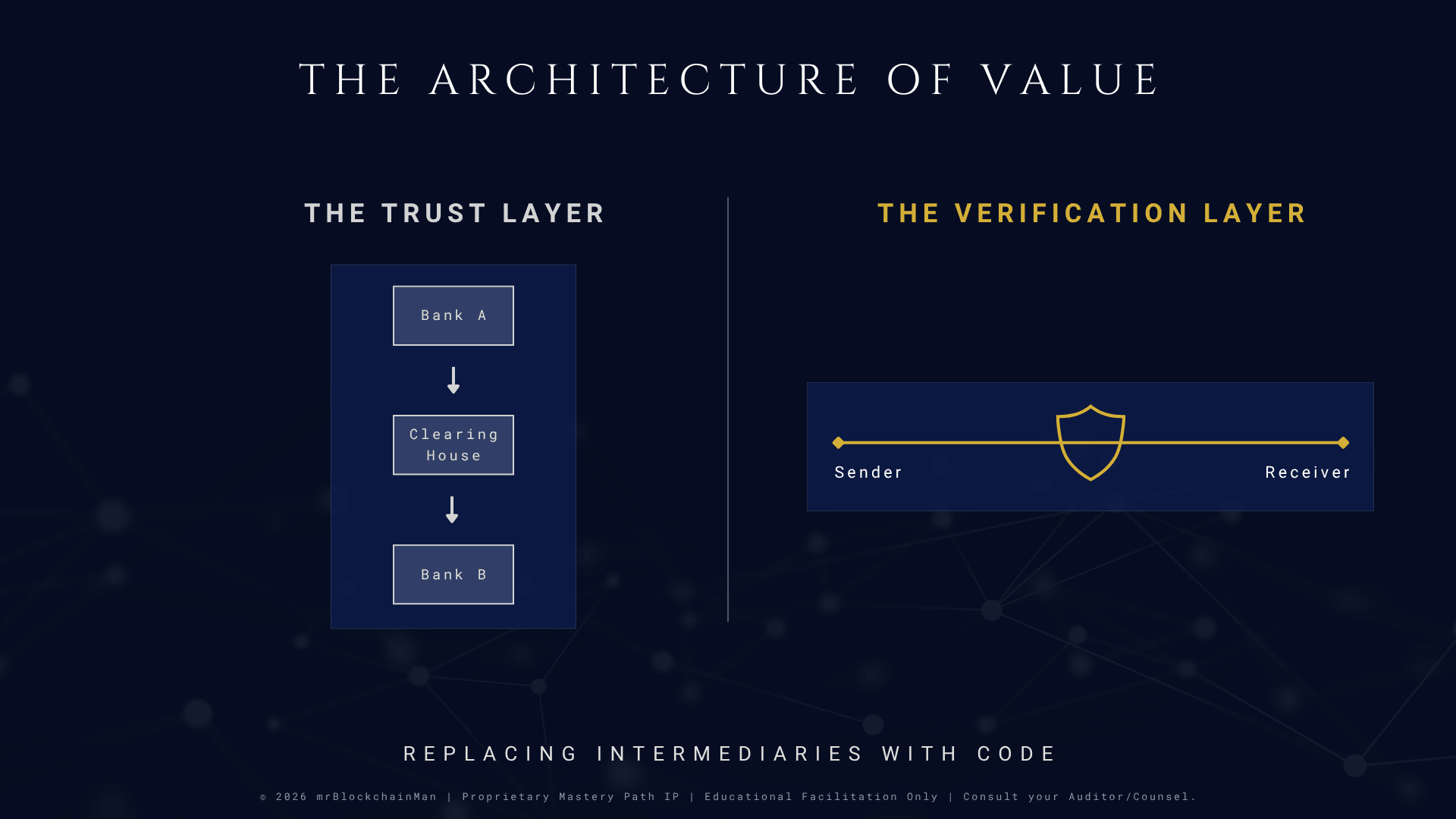
The legacy system relies on a “Trust Layer” (Bank A → Clearinghouse → Bank B). Digital assets utilize a “Verification Layer” (Sender → Code → Receiver), replacing expensive intermediaries with code.
The CFO’s New Mandate: From Steward to Strategist
Navigating this new on-chain economy is the modern CFO’s new mandate. It is about managing new risks, but more importantly, about seizing new opportunities for efficiency and growth.
This is no longer a niche experiment, but a mainstream force demanding institutional-grade expertise. As a financial leader, you have two choices: You can observe from the sidelines and lose your competitive edge, or you can govern.
A Framework for Stewards of Capital
This is not a technical manual for speculators; it is a strategic framework for stewards of capital. That plan begins with a robust governance framework, the essential foundation for managing risk and unlocking strategic value.
Secure Your Digital Asset Governance Blueprint
Download the definitive guide to building a resilient, audit-ready treasury.